

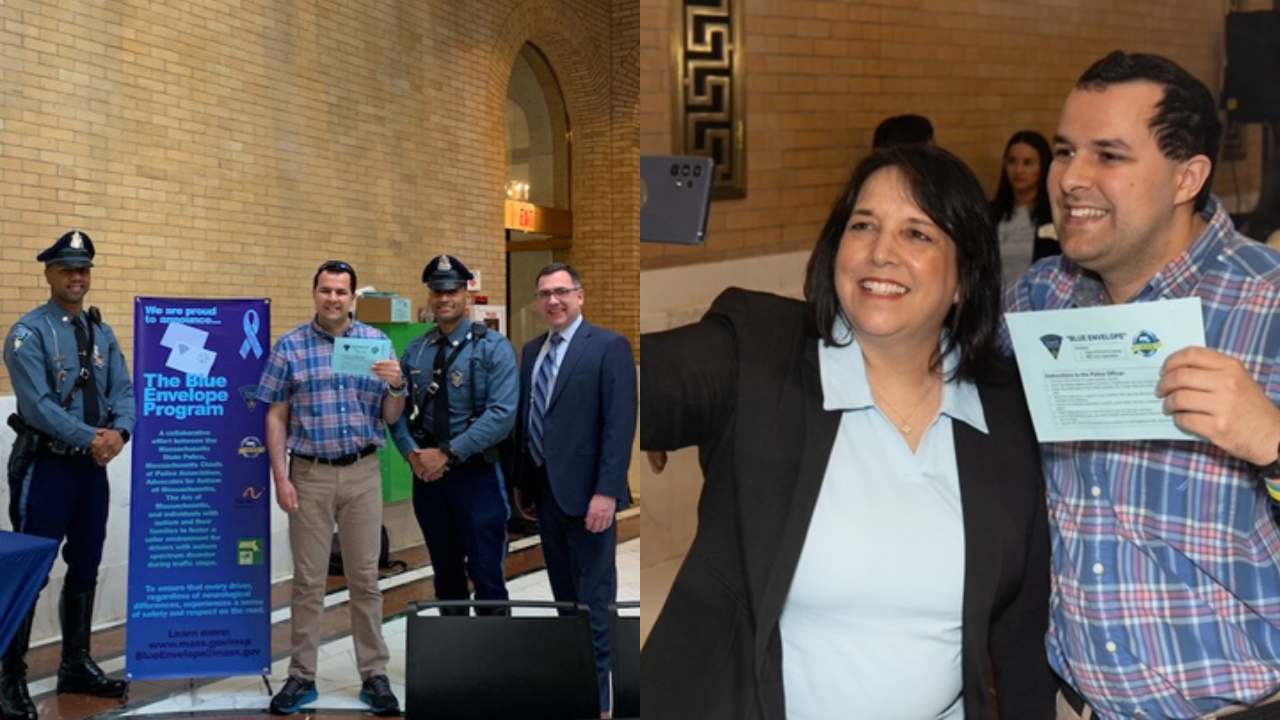
Signed into law by Governor Maura Healey on June 25, 2026, the Blue Envelope Program is a crucial tool to ease communication between individuals with autism and law enforcement. Following years of advocacy led by The Arc of Massachusetts and Advocates for Autism of Massachusetts, and in partnership with the Massachusetts State Police and the Massachusetts Chiefs of Police Association, this law ensures that the Blue Envelope program is consistently applied across the Commonwealth. Learn more at thearcofmass.org/blueenvelope.
Why were you interested in the Blue Envelope Program? Tell us a little about your family situation and what appealed to you about this program.
Ilyse Levine-Kanji: I knew immediately that the Blue Envelope would be a game changer for our family. My 28-year-old son, Sam, drives and has autism. Like most people with autism, Sam has no physical characteristics that alert others to his diagnosis. Strangers are often confused by Sam’s presentation until they interact with him for a minute or two and realize he has a disability. Since police officers must make split second decisions when approaching a vehicle, the opportunity for Sam to simply hand an officer a Blue Envelope – without needing to find words – can clarify the situation immediately.
How has the Blue Envelope benefited your family?
Ilyse Levine-Kanji: Sam is more relaxed and self-confident driving with a Blue Envelope in his car. Our family is relieved knowing that the chance of a terrible misunderstanding is greatly reduced when Sam carries his Blue Envelope. The Blue Envelope also benefited our family by making me realize that I should explain to Sam what happens during a traffic stop or accident. I taught Sam to drive, but I never contemplated that he might get pulled over or be in an accident. Like many people with autism, Sam can become confused or anxious in new situations. Learning about the Blue Envelope motivated us to discuss what happens during a traffic stop or accident, ensuring Sam is better prepared if he encounters law enforcement.
What has been your experience with having the Blue Envelope?
Ilyse Levine-Kanji: Sam hasn’t used his Blue Envelope because he’s never been in a traffic accident or been stopped by police during his 10 years of driving.
Would you recommend other families get a Blue Envelope – and if so, why?
Ilyse Levine-Kanji: I recommend that other families get a Blue Envelope so that their loved one can choose whether to present the envelope if they come into contact with law enforcement. It’s difficult to predict how anyone – particularly someone with autism – will feel if they are suddenly pulled over or in an accident. Having the envelope as a “fallback plan” can be helpful. There are several other reasons to get a Blue Envelope. First, it’s a great way to organize your important documents so that you’re prepared during an accident or traffic stop. It’s also beneficial to read the tips on the outside of the Blue Envelope before driving to become familiar with what to expect during an interaction with law enforcement. Last, you can write a friend’s or family member’s contact information on the outside of the Blue Envelope so the officer can easily contact them, if needed.
Anything else you want people to know about this program?
Ilyse Levine-Kanji: The Blue Envelope is not a “get-out-of-jail free” card. If an autistic driver violates the law, they will be held to the same standards as a neurotypical driver. The Blue Envelope simply alerts law enforcement that the driver has autism so the officer realizes that unusual behavior or speech patterns may be a result of autism. The officer may then choose to use techniques to facilitate communication, such as lowering the volume of their radios or sirens, speaking in concrete language, and giving the driver additional time to process and respond to questions. Autistic passengers or community members can also request a Blue Envelope as a simple tool to alert law enforcement of their diagnosis and promote understanding and communication.